Showing posts with label bioware. Show all posts

Wednesday, February 11, 2015

Mass Effect 3 (2012) Review: Beating a Dead Horse Edition


Lucas Versantvoort / February 11, 2015

After the success of Mass Effect and the even bigger success of Mass Effect 2, everyone was awaiting with baited breath the game that would conclude the story of Commander Shepard in stunning fashion. And in 2012, the game hit store shelves and sure enough, the game was memorable, though for other reasons than an ardent Mass Effect fan might hope.
            The story starts with Earth being attacked by the Reapers. You escape Earth in the SSV Normandy with your crew and spend all efforts on gathering as many allies as possible. Depending on your decisions in previous games, this might prove easier/more difficult than anticipated. It is up to you to try to make everyone see the bigger picture, that focusing on their own little quarrels doesn’t matter much if the Reapers wipe everyone out in the process. This amounts to you helping the other species and garnering favors and securing promises of aid against the final assault against the Reapers. Meanwhile, Cerberus, the organization you helped in the previous game, has turned against you, its leader (TIM) having a plan of his own of ‘ending’ the Reaper threat. Eventually, you are informed of an ancient Prothean superweapon that might prove key to wiping out the Reapers and saving the universe.
            So…the story. Is it any good? I’m going to go with the always highly useful answer of ‘yes and no.’ It is true that several sections are incredibly potent, but it’s offset against a plethora of narrative issues: drivel like Shepard’s nightmares about the one kid he couldn’t save on Earth. Puh-lease… You mean to tell me that after two games of allowing you, the player, to decide Shepard’s character through dialogue options and so on, now you’re going to actively write him as a dramatic character? I’m sorry, but it doesn’t work that way. What if someone’s renegading? After pragmatically killing of hundreds of enemies—and sometimes entire species— in cold blood over the course of two games, making Shepard go all emo about one boy just doesn’t work dramatically. I also remember this clichéd missions featuring a bomb on Tuchanka where the Turian Lieutenant Victus sacrifices himself to redeem his honor and save the rest and of course he goes out with a one-liner: “Victory, at any cost.”  I can almost hear the solemn trumpet solo in the background…
On the other hand, what the game does positively nail is the feeling of things coming to an end now that the Reapers have finally showed up. Even when I was just strolling through the Citadel, I had the feeling that I should get my ass moving and save the Universe. There was this constant air of melancholy permeating every second of the game. And that’s precisely the feeling that, for better and for worse, BioWare was going for with this entire game. It’s the same deal with Final Fantasy XIII: there’s little to no exploration, because the main characters are fugitives. In Mass Effect 3, the Reapers are killing everyone, so there’s little to no time for sightseeing (no exploring the homeworlds of the Turians and Asari); there’s only a race against time to gather as many allies as possible and defeat the Reapers.
            All in all, the story is flawed (to speak nothing of the ‘radically different’ endings), but there are times, as I said, when it gets it completely right. The perfect example is the chapter involving the Krogan. This is where everything comes together, where the gameplay is tense, the storytelling is tight and the choices are meaningful. You can let Mordin sacrifice himself for the good of the Krogan future, or, if you did certain things beforehand, can save him as well. You can confront Mordin with your worries about future Krogan aggression and fatally wound him, etc. The great thing here is that it feels like a self-contained chapter that has a clear beginning-middle-end structure and builds on the themes connected to the Krogan and Salarians. It all comes together wonderfully. More importantly, it’s emotionally satisfying.
Speaking of which, that’s another problem with ME3, the fact that it has to tie everything together and make sure your that all your choices made in the previous games matter. It sounded ambitious when BioWare first announced its plans of letting you transfer saves from one game to the next, but in practice, it’s clear BioWare bit off more than it could chew. Rather than having all your previous choices make a real difference, they don’t mean a lot in the end, a fact emphasized by their being given a number of War Assets. Remember the huge decision at the end of ME2? Whether or not to destroy or save the Collector base? All that does in ME3 is give you a measly few War Assets…whoop-dee-fuckin-doo. That’s the problem when you’ve created a canvas as big as this: it becomes impossible to make all the player’s choices matter without most of them feeling inconsequential in the bigger scheme of things. The direct consequence is that you become more easily aware of the underlying machinations of what triggers what event. You quickly identify certain short scenes as being a little reward for you having done something in one of the other games. It doesn’t exactly enhance the narrative flow when you’re like “oh okay, he shows up, because I did this in ME2.” You instinctively realize it doesn’t really matter. Minor characters make little more than glorified cameos for one scene and are never seen again. It’s the same thing that plagued ME2. To save or not to save the Council; that was the big question at the end of ME and all it meant in ME2 were a few pointless scenes featuring the Council, that’s it. It didn’t change anything substantial.
In terms of gameplay, the game suffers from/enjoys the same features that separated ME2 from the first game. Just like ME2 was more of a shooter than an RPG, ME3 symbolically does away with all RPG elements and goes into full-on Gears of War mode and never looks back. Oh sure, BioWare may have claimed they’d introduce “added RPG elements,” but the simple fact is that no one in their right mind would consider this an RPG. Even the classes themselves aren’t truly unique enough to provide for radically different gameplay styles. In the end, it all boils down to moving and shooting, getting behind conveniently placed cover and shooting, and so on…
Ugh...
            And don’t even get me started on War Assets, a feature with which you can keep track of the support you’ve gathered throughout the game (individuals, armies, technology and so on). What baffles me is that it flat out tells you the minimum number of points necessary to even get access to one of the main endings. It’s so immersion-breaking it defies belief. So let me get this straight, you spend three games immersing yourself into this universe and all these characters and prepare for the coming onslaught of the Reapers and now you get a system that blatantly tells you when you are ready to defeat the Reapers, the almighty species against which victory is nigh impossible? Yeah…do you see how that doesn’t really fit into an emotional storyline where you desperately fight to save the universe and everyone in it? What kind of computer is even able to predict this, anyway!? I understand that a game in the end is entirely ‘technical,’ that it takes into account certain variables and that you are assigned a certain ending as a result and all that, but how about we don’t confront the gamers with this emotionally inert nonsense? You’re supposed to effectively suppress aspects of game design, not shove it into people’s faces. Right after reaching the minimum amount of points necessary, I remember thinking, “well, no matter what I do, I guess I’m now able to defeat the Reapers.” Not exactly the kind of emotional response you’d want to get out of a dramatic narrative. What's worse is that you need to compete online for assets, otherwise you can only gain 50% of all assets. So, 50% is gained through single player, while the rest through online multiplayer and iOs/Android apps. I was furious when I first discovered this, cuase it felt my single player experience was being fucked around with by needless online components.
            Other things that left a bad taste in my mouth are little things like BioWare’s decision to increase Ashley and Liara’s cup sizes for what I’m sure was a very valid reason with lots of narrative implications. Even worse is the inclusion of Jessica Chobot as reporter Diana Allers who you can take with you on the Normandy, so she can ‘broadcast the truth to the people’ and all that. You can romance her, but it’s just a fling, so why would you? For those of you who don’t know, she was involved with IGN at the time, which casts an all the more dubious light on not just her casting, but on the notion of ‘objective video game journalism.’ Just this casting choice alone can easily make me dislike the game as a whole, depending on my mood. BioWare also screwed up side quests, more specifically the giving of objectives. Most side quests involve only going to some planet and find some object or something, but the objectives don’t necessarily state which planet you’re supposed to go to and even when they do, you’re not told exactly where it is. Apparently, you’re supposed to just wander the galaxy and hopefully stumble upon the right planet at some point. How do you screw up something as simple as side quests? Another “new and exciting” feature was that you could give voice commands through Kinect with a headset. How anyone could think this is what gamers want is beyond me. Because you know…sometimes I look at my controller and I think, “man, I wish I could just do away with all those buttons and just talk to my TV, because that would definitely increase my immersion into the game world and raise my enjoyment levels by at least 100%.” The entire notion is just ridiculous, a failed attempt at blurring the lines between your living room and the game world.
Just...wow...
            For what it’s worth, there were enough good moments to warrant my purchase of Mass Effect 3. The attempt here was obviously to create a stunning, emotionally compelling, cinematic finale and they somewhat succeeded. But for every compelling moment, there were things that annoyed me: the fact that ME2’s teammates can’t join you on your ship (BioWare instead obsessively focused on ME’s cast and gave ME2’s cast a couple of cameos for good measure), the lack of conversations with your teammates, the immersion-breaking War Assets, the lack of differences between classes, Diana Allers, the fucking cup sizes, the relatively boring new characters, the obvious appeasing of the LGBT community by shoving gay romances into the proceedings (I have nothing against gays, but it’s weird how Shepard and Kaidan can all of a sudden ‘bat for the other team’ even though this was never implied in previous games, not to mention how underwritten Steve Cortez was), EVE’s hot cyborg body, the dream sequences, not to mention the endings themselves…and that final screen... BioWare tried and occasionally succeeded, but they bit off more than they could chew here.

Mass Effect 2 (2010) Review


Lucas Versantvoort / February 4, 2015

After the incredible success of the first Mass Effect in 2007, developer BioWare knew it had a franchise on its hands and merrily went on its way to develop the sequel. Mass Effect 2 was released in 2010 to even more critical acclaim than its predecessor. Though fan debate still persists as to which one of the two is better, it was undeniable that it was a success.
            The story kicks off several weeks after the ending of the first game. Our ship, the SSV Normandy, is attacked by some kind of enemy ship and everyone’s forced to evacuate. Commander Shepard is unable to escape in time, however, and so dies from suffocation. Naturally, this being the beginning of the game, nobody’s doubting Shepard’s eventual return. (So much for dramatic purpose…) Shepard’s body is recovered by Cerberus, a pro-human organization. Cerberus, as opposed to the bureaucratic fuckwits on the Citadel, are very aware of the threat posed by the enemies (Collectors) that attacked the Normandy and, realizing Shepard’s immense charisma and leadership, spared no expense in recovering and reviving Shepard. This is two years later. Shepard awakens and hesitantly joins Cerberus. He is told by its leader, TIM, that the ship emerged from the Omega-4 Relay and that no ship has ever returned after passing through. Shepard is thus tasked with crafting a team of talented individuals, passing through the Relay and kill the Collectors that want to assume direct control over humanity.
"I'll relinquish one bullet. Where do you want it?"
            What first has to be said is that while this storyline sounds interesting, it really isn’t. In fact, it’s a typical BioWare placeholder while you complete the parts of the story that actually are interesting, the side quests involving your teammates. This is both the game’s greatest strength and its greatest weakness from a narrative point of view: while the recruit and loyalty missions of your teammates are great and allow for some great characterization, it also strips the main storyline of any tension and complexity for the most part, turning it into ‘here are the big bad aliens with some master plan that you don’t care one iota about, now go kill them.’ Overall, it’s quite a far cry from Saren, the first game’s antagonist who at the end is revealed to be a more complex character than you thought and whom you could actually reason with at the end. And what do we get in Mass Effect 2? Giant enemy crabs… Even worse is that the main threat mentioned in the first game, the Reapers, are pretty much AWOL in this game, only revealing themselves at the very end, like a friendly reminder, ‘hey guys, yep, we’re still here and we’re still invading.’ Particularly now, when the third game’s been released and we can judge the trilogy in retrospect, do we see how the Collectors storyline is pretty much filler in the bigger scheme of things.
            Thankfully, the missions involving your teammates pretty much save the day and they’re effective enough to make you forget about the main storyline’s weaknesses. Whether it’s helping Garrus get revenge or convince him not to, or helping Jack deal with her past life in a Cerberus prison facility, or defending Tali when she unfairly faces exile, etc., it’s all pretty engaging and forms the emotional core of the whole experience. Indeed, this game is a very good example of what people mean when they say that characters are what define BioWare’s games, which is indeed the case here as they draw attention away from the poor main storyline. Though the main story does feature the excellent final suicide mission, it is mostly due to the bond you’ve developed with your teammates that the mission is as tense as it is.
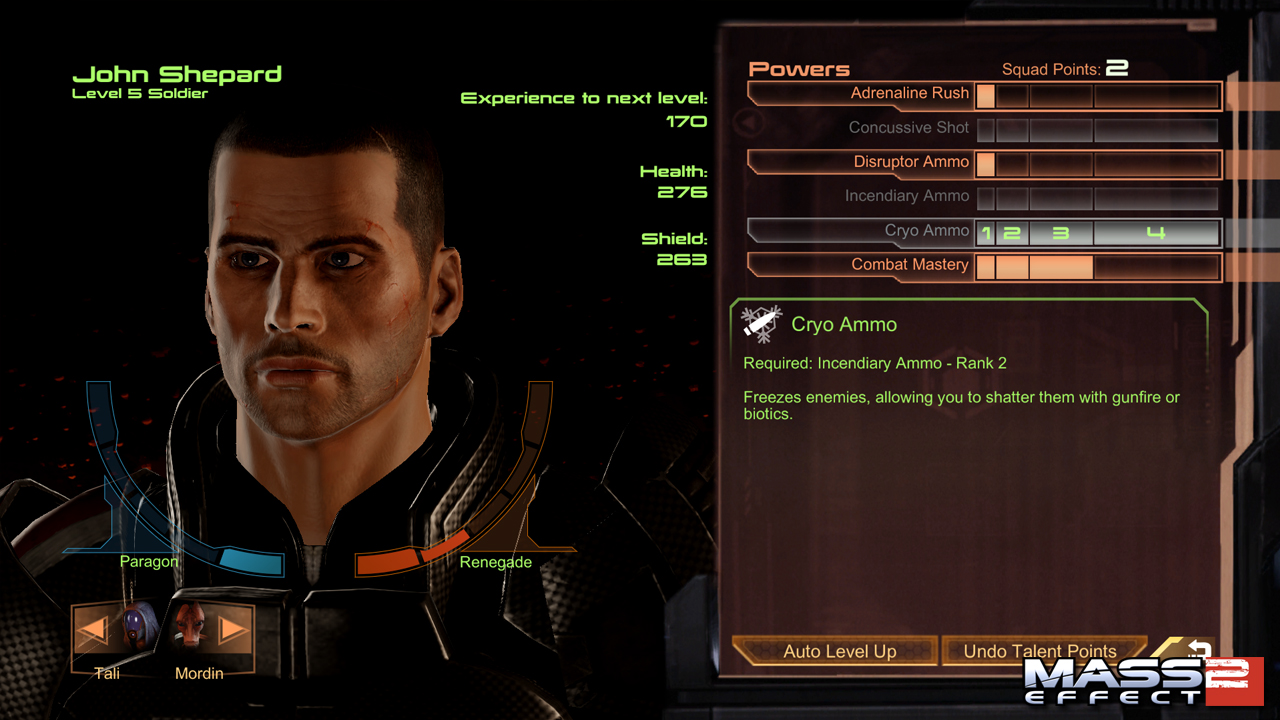
            Now, the gameplay. This is where things enter Your Mileage May Vary territory. It’s obvious BioWare took the gameplay of the first game and streamlined it, reducing various RPG elements and turning the whole deal more into an action-packed third-person shooter. If that’s your thing, then it won’t bother you at all. In fact, you will probably appreciate combat more now that the experience has been ‘tightened.’ On the other hand, if you belong more to the RPG crowd, you’ll spend combat lamenting the presence of regenerating health and the reduction of things like talents. One need only compare this and this to see what I mean. Personally, I can’t help but feel BioWare, now that EA was their publisher, either wanted or was told to look to Gears of War for ‘inspiration’ so that they might hope to widen their audience. Unfortunately, decisions of this nature in the end mostly serve to anger the series’ loyal fans as they start bemoaning the loss of RPG elements and what not, so you have to wonder what’s the preferred option here: alienating your fan base for a few extra copies sold, losing sight of your game’s unique aspects in the process or just ‘be Mass Effect’? As for me, I’ve never really loathed the gameplay so much as tolerated it.
Oh man, this is way too fun for me...
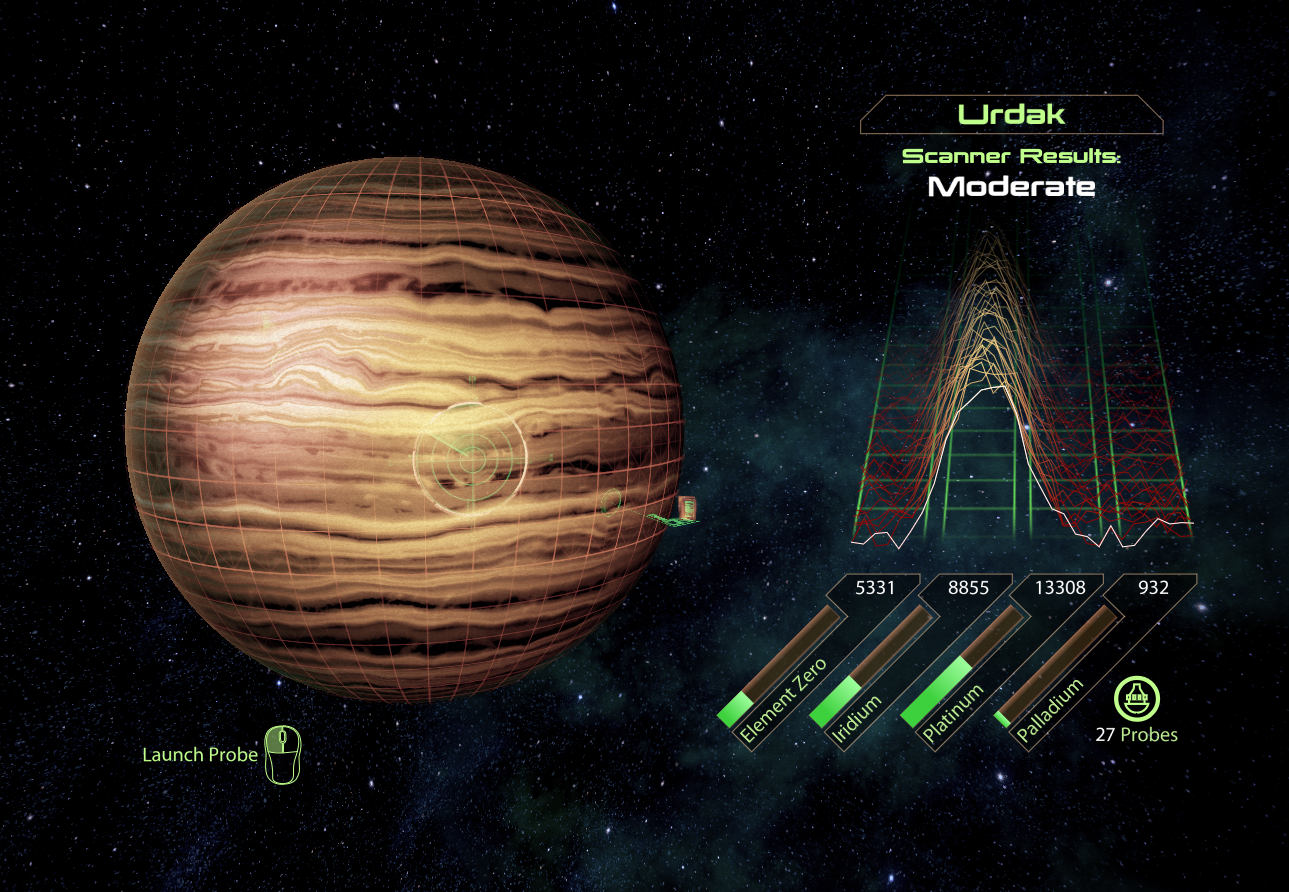
            Something concerning gameplay that’s always baffled me was the positive critical reception of scanning planets for minerals and what not. This basically boils down to accessing a computer, selecting a part of the planet that the scanner indicates is rich with minerals, launching a probe and automatically collecting the spoils. That’s it. Why online critics praised this mind-numbingly boring busywork continues to mystify me, especially considering that in the first game you could actually control a vehicle and explore planets. Sure, there was extremely little to do there, but at least you were out there, exploring. Instead, you get to analyze every single planet in search of various types of minerals in a way that anticipated BioWare’s embracing of endless ingredient farming in Dragon Age: Inquisition. The criticism that in that Inquisition you’re a leader reduced to gathering item farming is also valid in Mass Effect 2. Why can’t I tell some of my subordinates to gather minerals while I tend to some of the more important matters at hand, like saving the universe: “Sorry guys, I’m a bit busy with recruiting and psycho-analyzing my teammates and saving the human species from the Collectors, so could you do me a solid and take on the almighty task of gathering minerals by yourselves?”
            Also, the morality system returns. Like the first game, you’re allowed to engage in conversation and depending on your responses and actions, you’ll either fill your Paragon or Renegade meter, aka good guy or bad guy. This is all fine and dandy, but the main problem is twofold: first of all, due to the dialogue wheel you’re always aware that the upper right options are the Paragon options and the bottom right the Renegade options. As a consequence, you can basically shut your brain off during conversation, because if you’re paragoning, all you have to do is always select the upper right option. Mass Effect 2’s story throws all kinds of tough moral subjects and questions at you, so it’s disappointing that responding to these things requires no intellectual effort on your part. Secondly, a handful of times the upper right option doesn’t ‘feel’ like the Paragon option, like at the end of Legion’s mission, where you decide between rewriting the Heretics’ code or destroying the base, the first option being the one that grants you Paragon points even though it seems like the artificial intelligence version of brainwashing. Another example is when you romance Miranda and she, towards the final suicide mission, begs you to promise her that you won’t die, as your death would be too devastating for her. The upper right option causes Shepard to say, “I died once already. I don’t plan on doing it again” while the middle option makes Shepard tell Miranda that he can’t promise her such a thing. Obviously, a great deal of gamers felt the middle option to be the more realistic one, the first option reminding of the scene from Team America where Lisa tells Gary that if he promised her that he will never die, she would make love to him right then and there, to which he unsurprisingly responds, “I. Promise. I. Wrisingly responds, “I. t of your time bonding with your teammates, the final mission is incredibly tense.ill. Never. Die.” Many gamers felt that telling Miranda he can’t promise such a thing was the more mature thing to do, so you can imagine their confusion that the ‘I will never die’ option was the Paragon option. Dragon Age: Origins handled conversation options much better with its simple list of options, because the order of options was always random and not listed from nice to evil. This naturally forced you to think carefully about your responses.
            All in all, you could argue that the downfall of Mass Effect, culminating in Mass Effect 3, started here in pure gameplay terms if nothing else, but it’s the characters that save Mass Effect 2. The characters are the sole reason why I’ve played through Mass Effect 2 over and over again. It’s my favourite game in the series. I like to compare it to Nolan’s Dark Knight Trilogy, where The Dark Knight, though featuring a narrative with zero connections to the overall storyline, is almost everyone’s favourite. Similarly, Mass Effect 2’s story is of almost no consequence in the bigger scheme of things, but is nevertheless a lot of people’s favourite game in the series.

Tuesday, December 9, 2014

Dragon Age: Inquisition (2014) Review: Bad Hair Day Edition


Lucas Versantvoort / December 9, 2014

After Mass Effect 3 disappointed in more ways than one (yes, it’s not just the ending that’s an issue) and Dragon Age 2 felt rushed compared to the majesty that was Origins, BioWare knew they had to reel their fans back in with some quality game design. It’s not for nothing Dragon Age: Inquisition was delayed. For better or worse, Inquisition had the aura of being an apology to gamers. BioWare was determined to give gamers a game of massive size and scope, a culmination of everything that made them famous: the ultimate BioWare game. If professional reviewers are to be believed, Inquisition is as a splendid return to form for BioWare. While that’s partially true, the game’s definitely not without its faults. Warning: though I quite like the game, adequately conveying my complaints takes time, so it might sound like I’m bashing Inquisition, but to BioWare that’s probably become the same as being ‘a passionate fan’. Also, spoilers.
            The action takes place right after the events of Dragon Age 2. By blowing up the Kirkwall Chantry, Anders unleashed years of tensions between mages and Templars, culminating in war. Seeking to end the war, a Conclave is called for that includes important representatives from both parties to discuss peace. The main character finds himself/herself there, but something goes wrong. The whole place explodes and a massive rift appears in the sky which also causes other ‘mini-rifts’ to appear. By being in the wrong place at the wrong time, you also find yourself with a strange mark on your left hand which gives you the ability to close the rifts. This makes you something of a hero in the eyes of an ever-growing number of people and you soon find yourself at the head of an inquisition, seeking to gain allies amidst all the political turmoil and close the rift in the sky.
            So yeah, story-wise this is without question a BioWare game where you play as one gifted individual trying to save the world with your companions. BioWare has been using this formula since its conception and it’s not hard to see why: you get to explore different places, interact in various ways with your companions, etc. What’s not to like? It’s a formula that has a lot going for it, though you know it’s getting derivative when charts like this one pop up…
            What I particularly like about the main story is the actual structure. You form the inquisition at your base, Haven. You rally those around you, complete quests, etc. Then after a few missions you close the rift and it’s party time…or is it? Naturally, the threat remains and Haven is attacked. After a narrow escape, you regroup with the survivors and seek refuge in an abandoned fortress in the mountains, Skyhold. I like games that pull the rug from under you and change it up like this, like when you’re separated from the group in the desert in Final Fantasy X.
            The game is also positively enormous. There’s main quests and then there’s side quests and those side quests might have side quests and some missions lead to other missions. The amount of content is dazzling, especially for BioWare. This is particularly felt when you enter your first big area, the Hinterlands. You could easily spend the first ten hours of the game there, claiming camps, defeating enemies, helping people, closing rifts, farm items for crafting, etc. I feel sorry for the people that like to 100% their games. On the other hand, replaying the game is now ten times more tiresome because of all the content. You’ll most likely want to replay the game to make different decisions and pursue other romances, not recapture the same camps and finish the same side quests over and over. Also, the main storyline, which is already underwhelming, loses focus. Whereas everything you did in Origins had to do with gaining allies to combat the Blight, many if not all of Inquisition’s side quests can feel…random and pointless. BioWare of course tries to link it all to the theme of 'strengthening the inquisition' by letting you earn Influence and Power after every mission, but that doesn’t change the fact that you lose interest in the story after hours of wandering the game’s vast locales...which in itself gets boring fast. I remember getting to Emprise du Lion and doing nthing but fighting the same enemies over and over again, waiting for a quest to show up that had some actual content to it. Save for the occasional party banter, nobody spoke, until I stumbled upon a dying woman who wanted me to put a letter in a tree. For the first time in hours, my inquisitor actually said something! Inquisition is now a game with two features: a main storyline and a big sandbox with chores side quests. Not only has BioWare's Skyrim-esque escapades led them to create an open world with zero emotionally compelling content (in that sense they copied Skyrim quite well...), but the main story has also suffered as a direct result. BioWare's made Inquisition a jack of all trades, master of none.
Your companions are overall an improvement over those in DA2. Though even after roughly 80 hours of play, I still haven’t really gotten to know them all (aka finish their personal quests, etc.), I didn’t have the problems with them like I had with those in DA2, except for one, Gollum Sera. I’m sure she has an interesting backstory and all that stuff, but her character has the worst introduction ever. There’s no appeal in recruiting her whatsoever beyond it giving you access to extra missions, etc. Basically she makes no sense. She speaks English of course, but does it in a way that suggests she fell on her head at some point. She’s to Inquisition what Merrill was to DA2; that awkward feeling when you realize Sera and Merrill are supposed to be funny/endearing but are in actuality mostly annoying. I know I should take the time to invest in her character before judging, but the fact that it would require considerable effort on my part doesn’t help. Shouldn’t I feel emotionally compelled to converse with my companions? Before the game was released, I remember expecting a badass rogue of sorts (who simply cuts her hair when it gets in the way) and all I got was some crazy girl who makes no sense. Overall though, things are mostly solid character-wise.
Generic appearance? Check.
Generic motivation? Check.
Ladies and gents, I think we've got ourselves
a boring antagonist.

However, the story does a number of things really wrong in my opinion. First of all, the main antagonist (Corypheus) isn’t interesting…at all. He has the typical over-the-top look of a generic fantasy supervillain and his motives aren’t that engaging. Plus he doesn’t show his ugly face much either which doesn’t help. And when he does, you always foil his plans. Ironically, for a villain with such world-threatening plans, he’s as neutered a villain as possible. But I can deal with that as writing villains isn’t BioWare’s strong suit anyway. What disappointed me most however was the scope of the story. I know that’s a strange complaint considering the fact that the world of Inquisition is enormous both in actual size and content. What I’m referring to is where the story stops. (Spoilers) Throughout the game, you’ll get the idea that the story will go on after you’ve defeated Corypheus. Your companions discuss with you what the world after Corypheus will look like: who will be the next Divine? Will the inquisition be perceived as a military threat? Will you be betrayed by those around you who may not agree with your post-Corypheus worldviews? There’s a trippy mission where you’re in a dream/Fade (whatever) and a demon confronts you with visions. You walk through a dungeon where you see your companions behind bars, wondering why you, the Inquisitor, put them there. Unsurprisingly, I thought this was a possible future depending on my choices, a future where I’m a merciless despot. A Chantry mother told me I could shape the inquisition into something that will save the world or destroy it. At one point, one of your companions actually tells you that after you’ve defeated Corypheus, many in the world might see you as a threat to their power and will be very eager to “knock you back down.” What all of the above told me is that Corypheus is not the main antagonist, but the world of Thedas and all the important players in it. I thus eagerly awaited the moment I would defeat Corypheus and the story would continue! It’d be revealed that—depending on my actions—several world leaders (and perhaps also some of your companions!) would now turn against the inquisition. This would drastically improve the story, I think. It would go from ‘defeat supernatural antagonist to save the world’ (boring) to something concerning the complex political landscape of the world and its people (interesting). This would bring it far closer to the theme of “saving the world from itself,” a statement made by BioWare. It could’ve all been so much more interesting and emotionally engaging. Now you have a game that just ends when you defeat The Big Bad, like pretty much every game ever made. For me, this is by far the game’s biggest letdown, because there was an opportunity for Inquisition to separate itself from the pack.
I also didn’t like how the plot often took the easy route by having Corypheus magically take control of people’s minds. I get that complaining about this kind of stuff in a fantasy game makes no sense, but the best kind of drama comes from characters with complex emotions, motivations and worldviews, not deus ex machina plot twists that include magical mind control. I’m not suggesting the entire game suffers from this. Not at all, but I just think it reduces the possibility of truly engaging drama. It allows the game to easily explain why Corypheus has an army at his disposal which is a shame, because the game suggests many of his followers share his motivations (to restore the Tevinter Imperium back to its former glory). It might’ve been more interesting to make that purely the source of his popularity and not some magical mind control nonsense. In my Dragon Age II review I made a similar statement regarding Meredith and the Arishok. Whereas Meredith’s mind was corrupted by a magical artifact (boring), the whole plot regarding the Qunari was purely based on characters with conflicting worldviews and motivations (interesting). It’s not for nothing Meredith is universally reviled and the Arishok universally liked. Had Inquisition reduced the magical nonsense factor, I feel it would’ve been all the better for it.
And what about the occasionally ‘unnatural’ sounding dialogue? I understand that a game taking place in what are basically medieval times will require somewhat more ‘fancy’ dialogue, but at what cost? There were quite a number of times where it didn’t feel like you were actually talking with someone. This is only hampered by the countless conversation options that boil down to “I’d like to know more about…” In its defense, there are many times the dialogue shines. I vividly remember a conversation toward the end with Solas. He was worried about what I would do after the inquisition defeated Corypheus. I answered I’d consider the opinions of those around me. Solas disagreed, worrying I’d squander what I’d sacrificed so much to achieve. I can’t do what he said justice here, but that was definitely a highlight. Finally, I felt the passion behind a character’s spoken lines.
            Besides dialogue, there’s also the issue of Choice and Consequence, BioWare’s bread and butter. Make no mistake, the amount of auto-dialogue has been greatly dialed down compared to, say, Mass Effect 3. There are countless choices to be made and countless conversations to be had where you can assert the kind of character you’re role-playing as. But I mostly wish to refer to the actual impact of these choices. I like little touches like Cassandra referencing your opinion on the Maker in a conversation way later in the game. Even if it’s just one line, that one sentence made me feel like the world and its people were reacting to me and my actions. However, I don’t feel many choices truly impact the story. It’s like most of your decisions are made in isolation from the rest. Completely conquering The Western Approach doesn’t change the siege at Adamant. Recruiting the remaining Grey Wardens only results in them appearing at Skyhold, but nothing is done with the risk of them being corrupted again. Saving Empress Celene or not doesn’t change the fact that you will get Orlesian support no matter what you do. This is all made worse by the fact it’s implied that so much hinges on these kinds of decisions. I appreciate that BioWare’s going for this feeling of you influencing people’s opinions and the war effort, how the landscape changes (inquisition camps, enemy spawns), etc. It’s all to suggest important, world-changing things are happening in the background while you’re playing, but it doesn’t really work here. It never comes together. Nothing really changes. A lot of what you do doesn’t rise in significance beyond ‘it gives you Influence and Power which unlocks areas and story missions’. The same goes for the companion quests. While they’re great on a standalone basis, they don’t really impact the rest of the game. You’d also think the approval rating would have some effect on the story (à la Origins where companions would defy you if pushed far enough or Mass Effect 2 where they would die if you didn’t do their personal missions), but no, besides the romances it doesn’t really influence anything. Sure, some of it might it influence the epilogue in a tiny way, but since the story’s basically over at that point, who cares?
The opportunity for tactical combat is there;
you just need to play on Hard or combat
will be a breeze.
I’m also uncertain about combat. DA2 attempted to please everyone (the people who liked Origins and the hack ‘n slash crowd) with a strange combination between strategy and hack ‘n slash that basically downplayed the tactical element. With Inquisition, BioWare obviously showed they listened to complaints levelled at DA2 and attempted a combination between Origins’ combat and DA2’s combat. Make no mistake, combat is deeper than DA2 and there’s lots of room for customization, tactical approaches, exploiting possible combinations of attacks, etc. But though a return to Origins’ combat is appreciated, I can’t help but feel they’re basically making the same mistake again. Rather than trying for a combination between combat styles to please everyone (a common trend in modern BioWare games!), maybe they should just go with one style and perfect it.
BioWare’s made no secret about the return of the tactical combat seen in Origins. Nevertheless, I found myself mostly breezing through combat. Only a handful of times was I forced to resort to the tactical overview to order to my companions around. Particularly humorous was a dragon battle toward the end. I was quite underpowered, so everyone was attacking and I just walked out of range and kept reviving fallen companions. If reviving companions would raise their approval ratings, I would’ve maxed them all out in that battle… Though this all might have more to do with me playing on normal difficulty. Higher difficulties would undoubtedly require me to carefully position my characters, rather than just jump in and hope for the best. But I’ve always played BioWare games for their stories and characters, so higher difficulties would just slow me down, though I will give it a whirl at some point.
On the technical side of things, problems also abound, like the animations. BioWare has never been known for pushing the limits in these areas, preferring instead to craft fictional worlds with interesting stories and characters. That’s fine, but the resulting flaws inherent to the animations are on full display here: from obviously reused animations from previous BioWare games to animation glitches and Uncanny Valley facial expressions, the gang’s all here. There often was a disconnect between what characters were expressing and how this was conveyed (or not) through animation. Obviously, it’d be impossible to utilize motion-capture for every single conversation à la The Last of Us (since that game is linear, it’s within the realm of the possible), but it definitely annoyed me. It’s definitely not game-breaking by any means, but I do believe—and this is crucial—that issues like ‘artificial’ facial expressions, texture issues, animation problems, etc. can come together to reduce the emotional impact of what BioWare’s going for. Consider the ‘the dawn will come’ scene. The inquisition has been run out of their home base, Haven, by Corypheus. You and the other survivors come together somewhere in the snowy mountains. Morale couldn’t be lower. Then one person starts singing a hopeful hymn. Slowly but surely the rest join in. It’s meant to be a revelatory moment and while it’s all well-sung, something’s missing. I can’t take it seriously, not truly. Maybe it’s the campiness that often haunts BioWare whenever they try to be dramatic, but there’s always something that catches my eye. I want to read the emotion in the character’s eyes, but it’s not there. The animations feel off. When a character appears, I notice the textures still haven’t loaded correctly. The list goes on. This may all sound nitpicky, but lump enough technical issues together and you easily ruin the emotional core of what you’re going for. People joke about Mass Effect’s crappy graphics and animations, but those games are still loved because they made gamers feel something. I’m not sure I can say the same for Inquisition. To again make the unfair comparison to The Last of Us, that game uses mo-cap and all the resources at its disposal to enhance the emotional impact of the story. The animations feel just right, the look in the characters’ eyes betray their emotions. While there are definitely times when Inquisition positively nails the facial expressions, this is something BioWare hasn’t come close to achieving on a consistent basis and it negatively impacts the intended emotional impact of their stories and characters.
            Also, glitches…glitches everywhere. Inquisition was developed for both current- and next-gen consoles and pc’s. Surprisingly, performance issues abound on all versions. I’m currently playing the PS3 version, so I’m undoubtedly getting the short end of the graphical stick. I can’t readily compare the versions performance-wise. The PS3 version however is troubled by lag, texture pop-ins, audio glitches (sound effects that appear several seconds too late), conversation glitches (the conversation might stay stuck during lines, forcing you to press skip which makes the game skip the next line), freezes (after roughly 80 hours of play, the game’s frozen up on me three times, forcing me to restart the game, but since the save file will have disappeared, you have to hope the latest auto-save wasn’t too far removed from the point the game froze), very slowly loading textures, etc. What pisses me off the most though is the lip-syncing. I don’t know if and how this affects other versions of the game, but believe me when I say that 99% of all lip-syncing feels off. I can handle pop-ins, audio glitches, but if the lip-syncing isn’t spot-on, full immersion becomes extremely difficult, because I’m constantly reminded of it. I’ve lost count of the times I was more worried about whether or not the lip-syncing was accurate than paying attention to what people were saying. This is the technical issue that needs to be fixed asap. Though supposedly the next-gen and pc versions aren’t free of technical issues themselves, it’s all supposed to look, feel and play a lot better…which isn’t a surprise.
            However, technical issues are patchable, provided BioWare is willing to expend the effort to do so on a continual basis. On the other hand, issues with storylines and characters aren't solved with a simple patch, which is why judging BioWare games on these key fronts—as I’ve mostly done—is more relevant.
So yeah, this game is definitely not perfect, but at the very least in terms of size and scope it’s miles above DA2, so that’s something. It’s obvious a great deal of effort went into making it, but for every thing Inquisition does right, it also does something wrong. I realize this review’s mostly paid attention to the negatives, but that’s because 1) they are plenty and 2) explaining why something sucks requires greater explanation. Inquisition does a lot of things right: overall, the characters are an improvement over those in DA2; Skyhold is wonderful (though its customization options are actually quite limited); combat is pretty fun and tactical provided you’re playing on higher difficulties; the story’s got a lot of good sections (though it all doesn’t come together), the game world is huge (which is both good and bad); character customization is deep (but flawed); the music is quite good; the list goes on. The game’s got so much going for it, it’s frustrating that I don’t feel it reaches true greatness. I’m definitely liking the game and everything it has to offer, but I don’t think I love it, despite my wanting to. Either way, Inquisition definitely did not "make awesome happen."


Stray observations:

That awkward moment when you realize DA2's Qunari storyline had more depth than anything in Inquisition...

On a side note, may I just say I positively adore the Tarot cards? Not only are they wonderful to look at, each character (save for Leliana, Josephine and Cullen) has multiple versions that reveal more of their personalities. Ironically, I think the reason I like them so much is that they hint at the passion underlying these characters, an aliveness that the game itself has trouble conveying.

While Origins allowed you to fully customize your companions' appearances and DA2 only had special armor that was unlocked after doing romances or special missions, Inquisition finds a comfortable middle ground by adjusting new armor to your companions' general appearances. This way, they maintain their unique identities while still obviously wearing different armor.

The question remains: will BioWare eventually figure out how to make hair?